
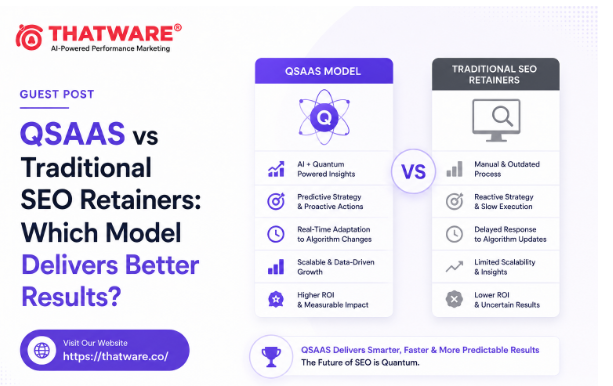
The SEO retainer model has been around almost as long as the SEO industry itself. You pay an agency a monthly fee; they allocate hours toward your SEO goals; you get reports, rankings movement (hopefully), and periodic strategy sessions. It’s familiar. It’s predictable. And for a growing number of businesses, it’s also insufficient.
QSAAS — Quantum SEO as a Service — is an alternative model that’s gaining serious traction, particularly with enterprise and mid-market companies whose scale and competitive environment has made the traditional retainer feel like bringing a knife to a gunfight.
But “different” isn’t the same as “better.” The right model depends on your situation, your goals, and your internal capabilities. This comparison is designed to help you work out which is which — for you, specifically.
How the Traditional SEO Retainer Works
Let’s be precise about what a traditional SEO retainer actually includes, because there’s significant variation in how agencies package them.
At its core, a traditional SEO retainer allocates a set number of hours per month toward a defined set of deliverables: technical audits and fixes, keyword research and content strategy, content production or content briefs, link building outreach, and performance reporting.
The quality and sophistication of these deliverables varies enormously between agencies — from commodity services that are essentially outsourced execution to genuinely strategic consultative engagements. But the model structure is consistent: hours traded for deliverables, with strategy reviewed periodically.
The strengths of this model are real. Experienced human strategists bring judgment, creative problem-solving, and nuanced understanding of client context that automated systems can’t replicate. For companies with straightforward SEO needs, complex stakeholder environments, or significant content production requirements, traditional retainers deliver genuine value.
The weaknesses become apparent at scale. A traditional retainer’s output is bounded by available hours. Analyzing thousands of pages for semantic coverage gaps takes months of analyst time. Building a dynamic internal link architecture across a large site is a multi-quarter manual project. Continuous real-time monitoring of algorithm signals requires infrastructure that traditional agencies rarely have.
How QSAAS Works Differently
Implement QSAAS strategy means plugging into a continuously-operating optimization infrastructure rather than purchasing hours of human attention.
The QSAAS model is built on:
Automated continuous analysis — The platform continuously analyzes the site’s content inventory, semantic coverage, entity associations, crawl patterns, and competitive positioning. This happens at a scale and frequency that human analyst teams simply can’t match — not because humans are less intelligent, but because machines don’t need sleep and can process millions of data points simultaneously.
Probabilistic opportunity identification — Rather than relying on analyst judgment to identify SEO opportunities, QSAAS uses quantum-inspired probabilistic modeling to identify and rank opportunities by expected value. The highest-value opportunities float to the top, regardless of where in the site’s vast inventory they exist.
Predictive trend forecasting — The platform continuously monitors external signals to identify emerging search trends before they peak, allowing content production to get ahead of demand curves rather than racing to catch up.
Real-time monitoring and alerting — Algorithm shifts, crawl anomalies, competitive movements, and ranking changes are detected as they happen, with automated alerts and prioritized response recommendations.
Human strategy is still involved in QSAAS — to interpret model outputs, make judgment calls, ensure brand alignment, and manage the execution of recommended actions. But the computational heavy lifting is handled by the platform, which dramatically changes the leverage of human expertise.
The Scale Threshold: When Each Model Makes Sense
The single most important factor in choosing between QSAAS and a traditional retainer is site scale.
Traditional retainers work well for sites up to a few thousand pages with clearly defined topical focus and manageable technical complexity. Below this scale, the overhead of QSAAS infrastructure isn’t justified — the platform’s analytical scale advantages don’t manifest when the site is small enough for human analysts to comprehend and optimize systematically.
QSAAS becomes compelling — and often necessary — as sites grow beyond this threshold:
-
10,000+ pages where comprehensive manual auditing is impractical
-
Multiple content verticals where semantic territory mapping across topic areas requires computational analysis
-
High content velocity (news, eCommerce, enterprise content marketing) where continuous freshness and optimization at scale is required
-
Highly competitive verticals where marginal improvements in semantic alignment and topical authority produce significant competitive impact
At enterprise scale, the question isn’t really QSAAS vs. traditional retainer — it’s which QSAAS implementation to choose and how to structure the human strategy layer around it.
The Results Question: What Does the Evidence Show?
This is where the conversation needs to be honest about what’s known and what isn’t.
QSAAS is relatively new enough that long-term longitudinal data comparing outcomes is limited. What we can say with confidence:
Short-term (0–6 months) — Traditional retainers often produce more immediately visible tactical wins: specific pages optimized, specific links built, specific technical fixes implemented. QSAAS in early months is often laying infrastructure (semantic mapping, entity architecture, crawl optimization) that doesn’t produce immediate ranking movements.
Medium-term (6–18 months) — QSAAS typically begins significantly outperforming traditional retainers in this window. The compounding effect of comprehensive semantic coverage, optimized crawl infrastructure, and dynamic internal linking starts manifesting in broader ranking gains and improved topical authority signals.
Long-term (18+ months) — The QSAAS advantage typically becomes substantial. Sites operating with continuously optimized semantic architectures and predictive content strategies build topical authority that’s structurally different from — and significantly more durable than — what traditional retainer-built content strategies produce.
The implication for planning: organizations evaluating QSAAS need to commit to an 18–24 month evaluation horizon, not a 90-day ROI window.
Cost Structure Differences
ThatWare Quantum SEO and other QSAAS implementations typically have different cost structures than traditional retainers.
Traditional retainers price on hours: you’re buying analyst and strategist time at an effective hourly rate. The cost scales linearly with how much work gets done.
QSAAS pricing typically includes a platform component (the computational infrastructure) and a services component (human strategy and implementation oversight). The platform component often has significant economies of scale — the marginal cost of analyzing 50,000 pages is not significantly higher than analyzing 5,000 pages once the infrastructure is in place.
This means QSAAS often has a higher entry cost at small scale and better cost-per-page efficiency at large scale. The crossover point varies by provider, but for most enterprise sites, QSAAS delivers substantially better cost efficiency once site complexity and content velocity cross certain thresholds.
Can You Run Both?
Yes — and for many organizations, a hybrid approach is optimal.
The most common effective structure is QSAAS for the computational infrastructure layer (continuous analysis, semantic mapping, predictive forecasting, real-time monitoring) combined with a traditional strategy and production team (either in-house or agency) that interprets model outputs and executes recommendations.
This hybrid preserves the human judgment advantages of traditional agency relationships while adding the computational scale advantages of QSAAS. It’s more expensive than either alone, but for large enterprises with complex content environments, the incremental investment is typically justified by the incremental performance gain.
The bottom line: if your organization’s SEO needs have grown beyond what human-hours-based retainer services can address effectively — and for most mid-to-large enterprises, they have — QSAAS deserves serious evaluation as either a replacement or a complement to your existing approach.